
Self-leadership: Lead Yourself to Lead Your Team
May 12, 2026

I was in session the other day with a client and she was sharing how busy she is at work. She is in management and has a lot on her plate. She loves her job most of the time and is working on more than a few interesting projects. But she keeps finding her workload increasing, and she has high expectations of herself when it comes to checking off A LOT of tasks. She goes home, and her work brain follows. Then she has a lot of other decisions to make when she gets home.
Can anyone relate?
I was already writing this article when we spoke and, honestly, I have conversations about this all the time. She, like me and most leaders, wants to say “yes” to it all, especially if we think it is productive and will increase our impact. But what she needed and wanted was to be able to say yes to what actually fit.
Leading by DESIGN’s LEAD 24/7 program helped me get there at a deeper level, and I am better able to help her now too.
3 Leadership Gaps That Catch Us Off Guard
Each chapter of LEAD 24/7 has given me so many great nuggets of wisdom. By the time my cohort got to Chapter 11: Leading Yourself, I felt like I could coast the rest of the way. This is where a huge part of my life’s work sits. I thought I had this part figured out. But then, we discussed the three issues Leading by DESIGN most commonly sees in leaders, and I was quickly humbled.
Here is a quick refresher:
- Avoiding difficult topics and conversations
- A lack of clear and bold vision
- Saying “yes” to too many things
Throughout the year, we had covered difficult conversations and vision often, and seeing this I realized #3 was also there. This chapter really brought that home. It goes on to say, “Not being willing to say ‘no’ to less important tasks when there is time available to say ‘yes.’”
Read that one again. It caused me to pause.
What it’s saying is that even though we could accommodate the request, task, project, you fill in the blank… doesn’t mean we have to or should. When we do that, it makes us SO busy, like the client I shared about.
Why Busy Isn’t the Same as Productive
She, me, and many of us believe that if we want to be productive, we need to “keep busy.” If we are a yes-man or yes-woman, we are a great leader and team player. Who doesn’t love an over-functioner who can get it all done?
A lot of achievers share that their sweet spot is when they are in action at work. The thing is, when we say “yes” too much, a lot of things happen that actually contribute to less efficiency, less output, and for most, at least a touch of burnout.
Taking a look at the graph about margin and impact showed how easy it is to go over the edge into burnout.
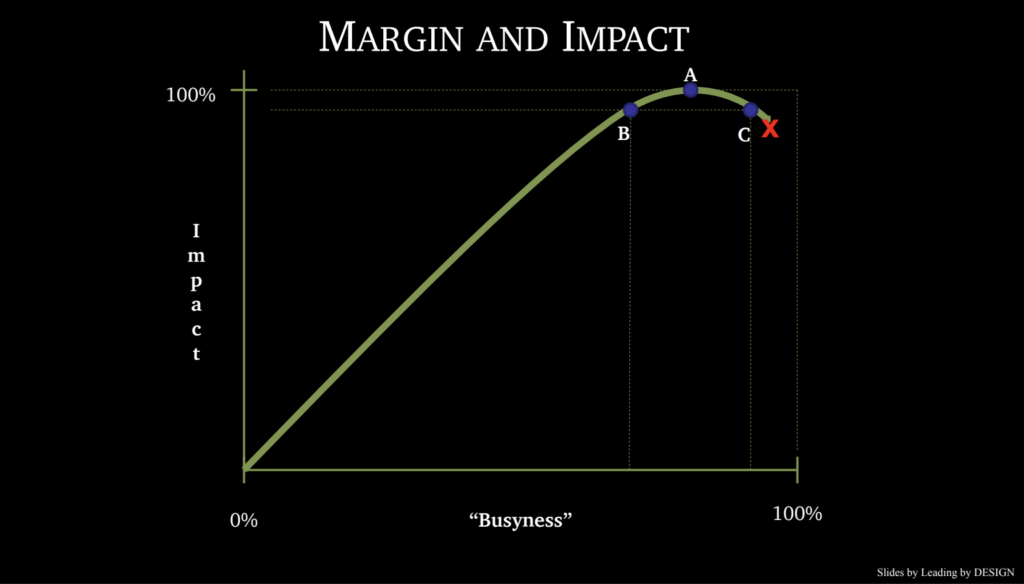
Digging a little deeper into the subtext, that says, “Being willing to say ‘no’ to less tasks even if there is a time to say ‘yes,’” leads us to consider what would happen next. Who would we be? What would we do? The Do-Know-Be Tree comes to mind here. If we mix it up and prioritize leading ourselves in those moments we could be doing less, where would that lead?
So, it is not only the number of things we say “yes” to, but also what we say “yes” to. Being too busy isn’t sustainable long-term and will affect your impact — your impact within your organization and your impact in your life.
A Simple Tool for More Intentional Commitments
Learning how not to say “yes” doesn’t come naturally for most personality types. We are wired for survival, and saying “yes” all the time often becomes part of our value system and identity. Revisiting Chapter 11 of LEAD 24/7 reminded me that this is a learning curve for me, but one that I want to be on.
Plus, the chapter provides a great tool. We can run our decisions to commit to something through simple checks and balances.
Here is the continuum:
- Is it a maybe yes?
- Are you on the fence?
- Is it a probably no?
- Or is it a no?
Do a gut check. If it is not a maybe yes, take the time.
When this was introduced to me in our cohort time, it sounded basic and obvious. But, as we went through the examples and applied it to our daily work and personal life, it was obvious I was saying “yes” to way too much while I was still on the fence and even when I knew I didn’t really want to.
Put It into Practice This Week
To put this into practice, check out your tasks and commitments for the week. Mandatory meetings aside, what else is there? Leading yourself means you get to decide what goes on the calendar. So, if you could do it over again, would you have said “yes?”
If you find yourself saying “yes” to things you know you probably shouldn’t do but do anyway, print the image above and hang it by your desk.
If you want more clarity, I have another tool for you. Create these three columns and fill it in with your weekly task list:
| Should | Could | Want to / Need to |
|---|---|---|
A lot of my life fell into the “Should” and “Could,” but I didn’t have clarity around what I wanted and needed to do. This applied to my daily work tasks all the way to committing to a vacation.
The Ripple Effect of Leading Yourself Well
I see Chapter 11 as a fitting closing to the LEAD 24/7 experience. It is an invitation to lead ourselves so that we can lead our teams better and live a better life. I set out to be more intentional with what I said “yes” to after Chapter 11. Going from busy to intentional has been a game changer.
I will close with another theme I see often in session. When my clients work for a leader who is experiencing burnout and not leading themselves well, it impacts them and their ability to thrive at work. We bring it back to how they can lead themselves through it.
Having gone through LEAD 24/7, I now have the awareness needed to know when I am experiencing burnout and how to be open to feedback about it. When I am in my sweet spot, I am more able to be present for difficult situations and conversations, be clear on my vision, and live into it boldy. I am also more decisive in my commitments both at work and in my personal life.
The ripple effect is that my team and others in my life benefit and are more empowered to lead themselves.
Written By:

Mercedes Saurbaugh
Founder & Owner of Into the Woods
Get Insights Delivered Straight to Your Inbox
Subscribe to our newsletter to receive monthly leadership, business strategy, and team building resources.
