
What is the DISC Assessment? A Leader’s Guide
August 27, 2026

Most leaders have taken a personality assessment at some point. Some found it useful. Others found it interesting for about a week and then forgot about it.
DISC tends to be different.
Not because it’s more complicated, but because it’s more actionable. It doesn’t just describe who you are. It gives you a practical framework for understanding how you lead, how you communicate, and how the people around you are wired to receive both. That distinction matters, especially when you’re trying to build a team that actually works well together.
At Leading by DESIGN, we use DISC with the leaders we coach because it opens conversations that most teams struggle to have on their own. In this post, we’ll walk through what DISC is, what the four styles mean in real leadership contexts, and how leaders actually put it to work.
Here’s what we’ll cover:
- What is the DISC assessment?
- The four DISC styles explained
- What DISC is not
- How leaders use DISC
- Why self-awareness matters more in the age of AI
- DISC at Leading by DESIGN
Key Takeaways
- DISC is a behavioral assessment that measures how people tend to act, communicate, and respond to their environment. It does not measure intelligence, values, or potential.
- The four styles are Dominance (D), Influence (I), Steadiness (S), and Conscientiousness (C). Everyone has elements of all four. Profiles show relative tendencies, not fixed types.
- DISC is a tool for understanding, not a box to put people in. Results describe patterns of behavior, not permanent traits.
- Leaders who understand their DISC profile communicate more effectively, manage conflict better, and build teams with greater self-awareness across the board.
- Research by organizational psychologist Tasha Eurich found that while 95% of people believe they are self-aware, only 10–15% actually are. DISC is one of the most practical tools for closing that gap.
What Is the DISC Assessment?
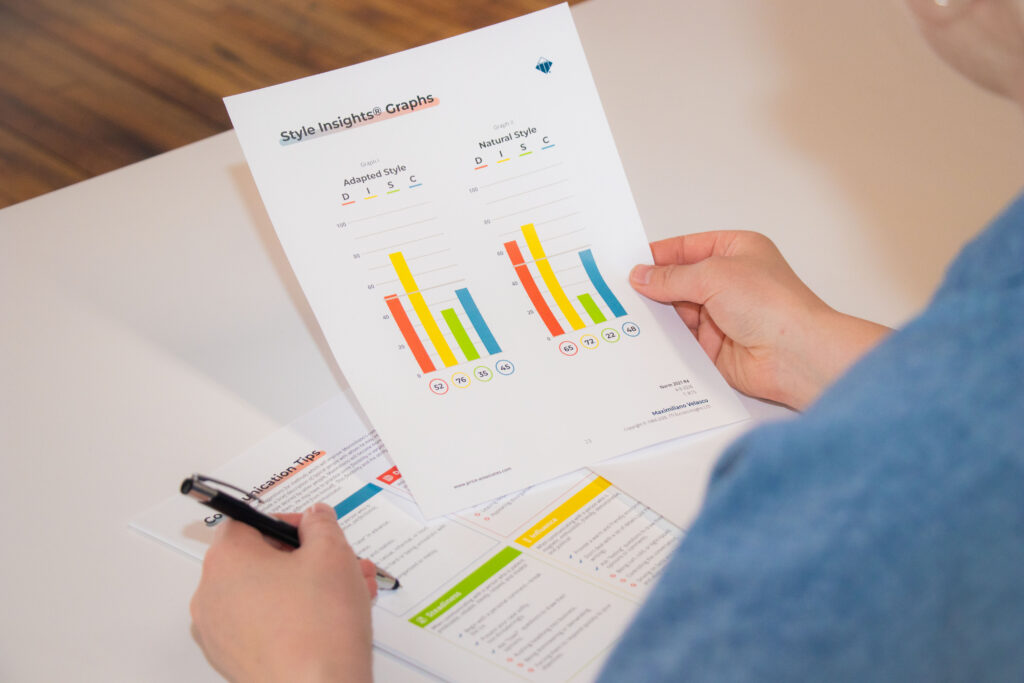
The DISC model describes four dimensions of behavioral tendency that shape how people act and interact in work environments.
The framework originated with psychologist William Moulton Marston, who outlined the four behavioral dimensions in his 1928 book Emotions of Normal People. Marston wasn’t building an assessment. He was developing a theory. Decades later, other researchers translated that theory into the assessment instrument most leaders know today. Since then, DISC has become one of the most widely used behavioral tools in the world, with tens of millions of people having taken some version of it across organizations of every size and sector.
What DISC measures is behavioral tendency, not personality type in the fixed sense. It captures how you naturally tend to approach problems, people, pace, and procedure: your observable patterns of behavior in a given environment. Because it’s behavioral rather than psychological, DISC results are practical and directly applicable to the everyday work of leading a team.
The Four DISC Styles Explained
Each DISC style reflects a different behavioral tendency, with distinct strengths, communication preferences, and potential blind spots.
D: Dominance. High-D leaders are direct, decisive, and results-focused. They move fast, make calls without hesitation, and tend to cut to the bottom line. In the best version of this style, they create clarity and momentum. The tension point: they can push so hard for results that they undervalue the relationship and process it took to get there.
I: Influence. High-I leaders bring energy, optimism, and connection. They’re natural relationship-builders who excel at rallying people around a vision and making others feel seen and valued. The tension point: the enthusiasm that makes them compelling can tip into inconsistency if follow-through and detail don’t get the same attention as inspiration.
S: Steadiness. High-S leaders are patient, reliable, and deeply loyal. They create stability on a team, listen before they speak, and hold context that faster-moving styles sometimes lose. The tension point: their preference for harmony can lead them to absorb conflict rather than address it, which costs the team over time. Our post on Healthy Conflict vs. Toxic Conflict covers why that pattern is worth addressing directly.
C: Conscientiousness. High-C leaders are analytical, systematic, and detail-oriented. They think before they act, ask the right questions, and build processes that hold up over time. The tension point: the pursuit of precision can create bottlenecks in fast-moving environments where a good decision now beats a perfect one later.
No profile is better than another. Each has real strengths that leadership teams need, and each has characteristic blind spots worth knowing about.
What DISC Is Not
DISC is widely used and often misunderstood, and clearing up the most common misconceptions is part of using it well.
DISC does not measure intelligence, emotional maturity, character, or potential. A high-D profile doesn’t make someone a better leader than a high-S. A high-C doesn’t mean someone is more competent. DISC describes how people tend to behave, not how good they are at anything.
DISC is also not a fixed label. Behavioral tendencies shift across environments. Most people show different profiles in high-pressure situations than they do when they’re at ease. DISC gives you a starting point for a conversation, not a permanent assignment.
And DISC is not a hiring filter. Using it to screen candidates in or out of roles creates legal and ethical exposure and misuses the tool entirely. Its value is in development, not selection.
How Leaders Use DISC
Leaders who get the most out of DISC use it as a communication and self-awareness tool, not a one-time exercise.
At the individual level, DISC helps leaders understand their natural communication style and where it creates friction. A high-D who leads a high-S team, for example, may be generating anxiety without knowing it: moving fast, skipping context, pushing for decisions before people feel ready. Knowing that creates an opportunity to adjust. Not to change who you are, but to stretch where it counts.
At the team level, DISC helps explain dynamics that teams feel but struggle to name. Why does this person shut down in meetings? Why does that conflict keep happening? Why does someone feel steamrolled in a process that seemed clear to everyone else? DISC doesn’t answer those questions definitively, but it gives teams a shared language to start working through them. That shared language is one of the reasons we bring it into the early work of LEAD 24/7.
Why Self-Awareness Matters More in the Age of AI
AI tools are changing the pace and volume of work for almost every leadership team. That changes the stakes around self-awareness.
Organizational psychologist Tasha Eurich’s research found that while 95% of people believe they are self-aware, only 10–15% actually demonstrate it. That gap was costly before AI. In an environment where tools can generate content, surface data, and accelerate decision cycles faster than any individual, the quality of human judgment and interpersonal skill becomes the real differentiator.
AI can synthesize information. It cannot read a room, regulate its response under pressure, or adjust its communication style based on what the person across the table actually needs. Those are human leadership capabilities, and they’re exactly what DISC helps develop. Leaders who understand themselves lead more effectively. That’s not a soft claim. It shows up in how teams communicate, how conflict gets resolved, and how decisions get made.
DISC at Leading by DESIGN
We incorporate DISC into our leadership coaching and into the LEAD 24/7 cohort program because it consistently opens conversations that move leadership development forward faster.
For most leaders, the assessment itself isn’t the aha moment. The aha moment comes when they sit with a coach or peer group and start connecting their profile to patterns they recognize in their own leadership. That’s when the insight lands in a way that’s actually useful.
DISC is one part of a larger development process. The goal is never the assessment. The goal is a leader who knows themselves well enough to lead others well.
Leading Well Starts With Knowing Yourself
Self-awareness doesn’t develop on its own. It takes the right frameworks, honest feedback, and a structured space to do the work. DISC is a starting point, not a finish line.
Learn how we use DISC and other tools inside the LEAD 24/7 cohort program at leadingbydesign.com →
Written By:

Leading by DESIGN
Communications Team
Get Insights Delivered Straight to Your Inbox
Subscribe to our newsletter to receive monthly leadership, business strategy, and team building resources.
